How to read a sewing pattern
Short answer. A pattern piece has two outlines (the stitching line and, outside it, the cutting line with the seam allowance), an arrow for the fabric grain, notches to match pieces, and a label with the piece name and how many to cut. If a piece says "on fold", that edge goes on the fold of the fabric.
A sewing pattern is a map: each piece is the outline of a piece of fabric, and its lines and marks tell you how to place it, cut it and join it to the others. Five symbols are enough to read almost any pattern, whether it comes from a magazine, a commercial PDF or Kutopy.
Lines and marks
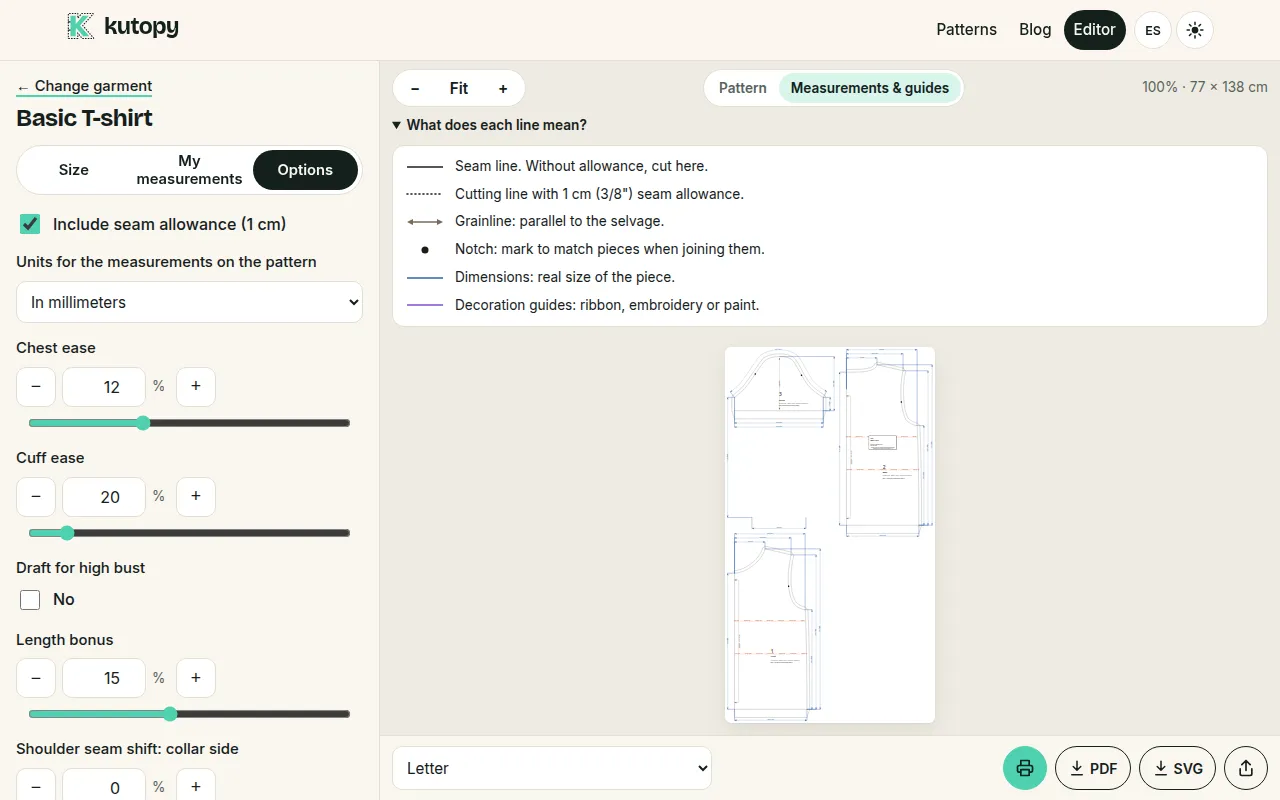
| Stitching line | Solid. You sew along it. | |
|---|---|---|
| Cutting line (with allowance) | Dotted, 1 cm (3/8") outside. You cut along it. | |
| Grainline | Double-headed arrow: parallel to the selvage. | |
| Notch | Mark to match two pieces when joining them. |
Kutopy's editor has the same key under "What does each line mean?", above the pattern, when you switch to theMeasurements & guides view.
The text on each piece
Inside each piece there is a number, its name and how many times to cut it. These are the usual instructions:
- Cut 2: two mirrored pieces. With the fabric folded you get both at once.
- Cut 1 on fold: the marked edge sits right on the fold of the fabric and the piece comes out whole, twice as wide. It is usually the centre back or centre front.
- On the bias: the piece is placed at 45° to the selvage so it stretches and follows curves, as in binding or drapey skirts.
- Lining or interfacing: that piece is cut from another material as well as, or instead of, the main fabric.
The grainline, the most ignored mark
The straight arrow on each piece has to sit parallel to the selvage, the woven edge of the fabric that does not fray. Measure from the arrow to the selvage at both ends: if the distance is the same, you are fine. A piece cut off-grain looks fine while you sew, but after the first wash the side seam twists towards the front. It is the most common fault in home-made T-shirts.
Notches: where pieces meet
Notches mark points that must line up when you sew: sleeve to armhole, front to back, waistband to centre. When cutting, mark each one with a 1/8" snip inside the allowance or with chalk. Sleeves usually have one notch at the front and two at the back, so you cannot set them in backwards.
Dimensions and cutting list
Dimensions give the real size of the printed piece. Use them to check that the PDF printed to scale and to see how the garment will turn out: if the chest width of the piece is smaller than you expect, check your measurements now, not after sewing. The cutting list on each pattern page sums up every piece with its quantity and material, so you do not forget one.
Before you cut
- Check the scale with the PDF test box (10 × 5 cm).
- Wash and press the fabric the way you will wash the garment.
- Lay out every piece before cutting any, with the grainline parallel to the selvage.
- Cut on the outer line and mark the notches.
If the pattern has no allowance, add it before cutting; see seam allowance. To print it properly, follow the printing guide.
 Try it with your measurementsSlip dress: few pieces, good for practiceOpen in the editor
Frequently asked questions
What is the grainline on a pattern?
The straight arrow on each piece. It goes parallel to the selvage so the garment hangs straight and does not twist after washing.
What is a notch in sewing?
A small mark on the edge of a piece showing where it meets another, such as the sleeve and the armhole. Mark it with a 1/8" snip into the seam allowance or with chalk.
What does "cut 2" or "cut 1 on fold" mean?
"Cut 2" means two mirrored pieces, cut at once with the fabric folded. "On fold" means that edge sits right on the fold, so the piece comes out whole and twice as wide.
Which line do I cut and which do I sew?
Cut on the outer line (with allowance) and sew on the inner one. If the pattern has no allowance, cut 3/8"–5/8" outside the line.
How do I know which line is my size?
Multi-size commercial patterns use a different line style per size. Kutopy patterns are generated for one size or your measurements, so there is only one line per outline.

