Seam allowance: how much to leave and how to add it to a pattern
Short answer. Seam allowance is the fabric between the stitching line and the cut edge. Big-4 US patterns use 5/8" (1.5 cm); many indie and European patterns use 3/8" (1 cm), with more at hems and zips. Kutopy patterns include 1 cm (3/8") by default and you can turn it off with a checkbox.
Between the stitching and the edge of the fabric there is always a strip: that is the seam allowance. If a pattern does not include it and you cut right on the line, the garment comes out a size smaller, because every seam eats the width of the allowance on both sides.
How much allowance for each seam
| Where | Usual allowance | Why |
|---|---|---|
| Straight seams in woven fabric | 3/8"–5/8" (1–1.5 cm) | 3/8" on European and Kutopy patterns; 5/8" on US commercial patterns. |
| Knits on a serger | 1/4"–3/8" (6–10 mm) | The blade trims the excess. |
| Necklines, collars and facings | 1/4"–3/8" (6–10 mm) | On tight curves a wide allowance pulls and puckers. |
| Invisible zip or fitting seams | 5/8"–3/4" (1.5–2 cm) | Leaves room to adjust without running out of fabric. |
| Trouser or skirt hems | 3/4"–1½" (2–4 cm) | Folded twice, it gives the hem some weight. |
The exact figure matters less than consistency: if you cut with 3/8", sew with 3/8". Most machines have marks on the needle plate to guide the fabric edge at that distance.
How to add seam allowance to a pattern without it
- Lay the piece on the fabric and hold it with pins or weights.
- With a seam gauge or a ruler, mark dots 3/8" (1 cm) from the edge every few inches. On curves, closer together.
- Join the dots with chalk. At corners, extend both lines until they cross.
- Transfer the notches onto the allowance and cut on the new line.
If you plan to fit the garment before sewing it for good, leave 3/4" (2 cm) at the side seams: taking in is easier than letting out.
Seam allowance in Kutopy patterns
Every pattern comes with 1 cm (3/8") seam allowance included. On the drawing, the inner solid line is the stitching line and the outer dotted line is the cutting line. If you prefer to work without it (to trace the pattern onto tissue or add your own), untick Include seam allowance (1 cm) on the editor's Options tab and the pattern prints on the stitching line only.
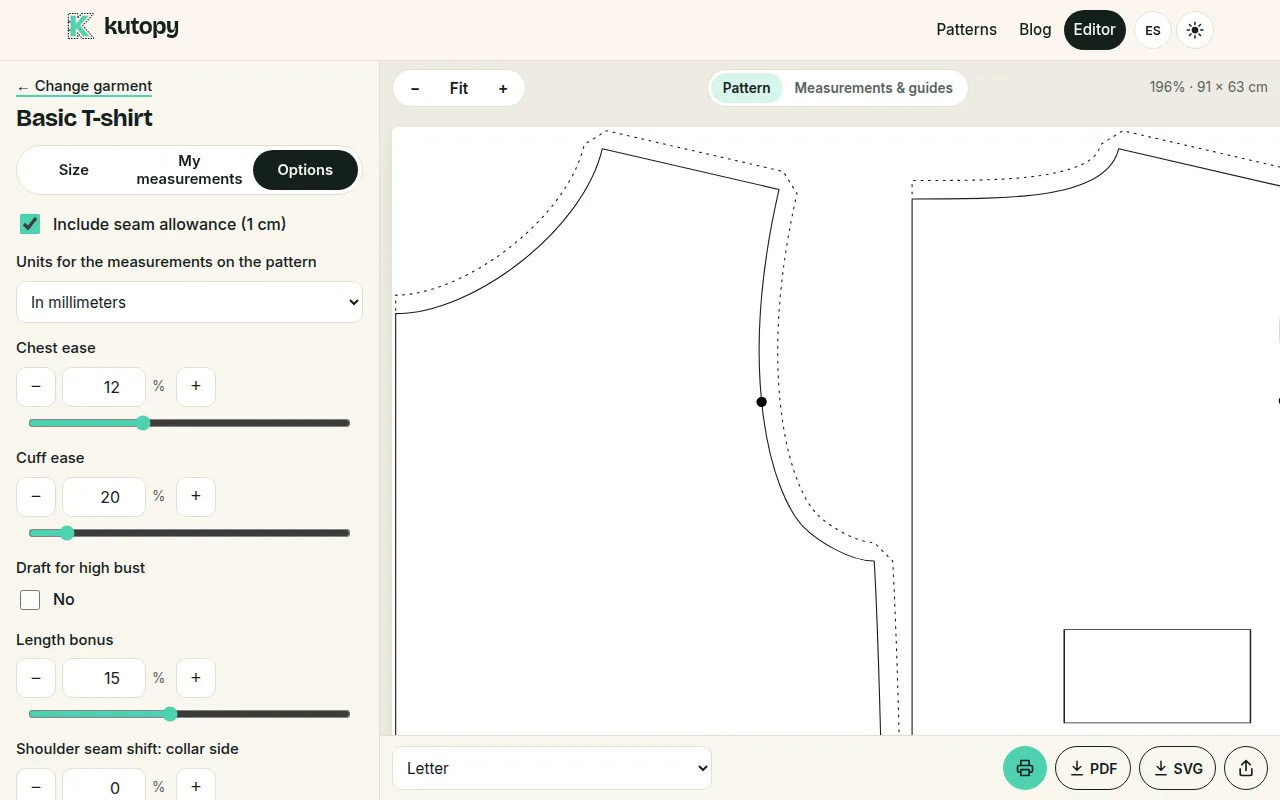
The fabric amount each pattern works out already includes the allowance. If you remove it and add a wider one, buy a little more; the fabric chart by garment shows how much each one usually takes.
After sewing: grading the allowance
At necklines, armholes and corners, the folded allowance adds bulk. Trim it to half its width close to the seam and, on curves, clip into the allowance without reaching the stitching. With several layers, trim each to a different width so they do not leave a ridge on the outside.
 Try it with your measurementsPencil skirt with 3/8" allowanceOpen in the editor
Frequently asked questions
What is the standard seam allowance?
In the US, 5/8" (1.5 cm) is standard on commercial patterns. Many indie and European patterns use 3/8" (1 cm). Hems usually get 3/4"–1½" (2–4 cm).
Do Kutopy patterns include seam allowance?
Yes, 1 cm (3/8") on every piece. If you prefer to add your own, untick "Include seam allowance (1 cm)" in the editor and the pattern prints on the stitching line.
Do I cut on the stitching line or the seam allowance line?
On the outer one. In Kutopy patterns with allowance, the outer dotted line is the cutting line and the inner solid line is the stitching line.
What if the pattern has no seam allowance?
Add it when you mark the fabric: draw a parallel line 3/8" or 5/8" from the edge of each piece with chalk or a seam gauge, and cut on that line.
Is seam allowance different for knits?
Knits often use 1/4"–3/8" (6–10 mm) because the serger trims the excess. A 3/8" allowance works on both a regular machine and a serger.

