Sewing patterns for beginners: where to start
Short answer. Start with garments that have few pieces, straight seams and fabric that does not slip: an apron, a split-side skirt, basic shorts or the zero-waste top. Then move on to a knit T-shirt and, once you can handle necklines and sleeves, a hoodie or trousers.
What makes a pattern easy is not the garment but how many pieces it has, whether the seams are straight and whether it has closures. A two-piece apron is an afternoon's work; a shirt with a collar, cuffs and twelve buttons can take a whole weekend even though it is "just a shirt".
A path for your first garments
Each step adds one new technique on top of what you already know:
- Apron: hems, patch pockets and ties. You learn to guide the fabric straight.
- Split-side skirt: your first gathers, a waistband and ties.
- Zero-waste top: a single piece folded along the marks, with no waste and no set-in sleeves.
- Basic shorts: your first crotch seam and an elastic waist.
- Basic T-shirt: knit fabric, a neckband and sleeves. The biggest jump on the list.
- Basic leggings: stretch knit and long seams, to consolidate the above.
Once those six are sewn, a sweatshirt or chinos will not scare you.
Every easy Kutopy pattern
| Pattern | Level | Pieces |
|---|---|---|
| Ghost costume | Very easy | 0 |
| Zero-waste top | Very easy | 1 |
| Split-side skirt | Very easy | 1 |
| Fabric face mask | Very easy | 1 |
| Roman tunic | Very easy | 1 |
| Roman cloak | Very easy | 1 |
| Medieval tabard | Very easy | 2 |
| Tie-on pocket | Easy | 1 |
| Skirt block | Easy | 2 |
| High-rise briefs | Easy | 2 |
| Knit block | Easy | 2 |
| Basic T-shirt | Easy | 3 |
| Cowl neck top | Easy | 3 |
| Fitted top | Easy | 3 |
| Basic leggings | Easy | 3 |
| Briefs | Easy | 3 |
| Swim trunks | Easy | 3 |
| Apron | Easy | 3 |
| 1790s shift | Easy | 3 |
| Vueltiao hat | Easy | 3 |
| Tank top | Easy | 4 |
| Slip dress | Easy | 4 |
| Sports bra | Easy | 4 |
| Rash guard | Easy | 4 |
| Basic shorts | Easy | 5 |
| Baby romper | Easy | 6 |
| Wrap pants | Easy | 7 |
| Necktie | Easy | 7 |
The level is shown on every pattern page and in the catalogue, under the garment name.
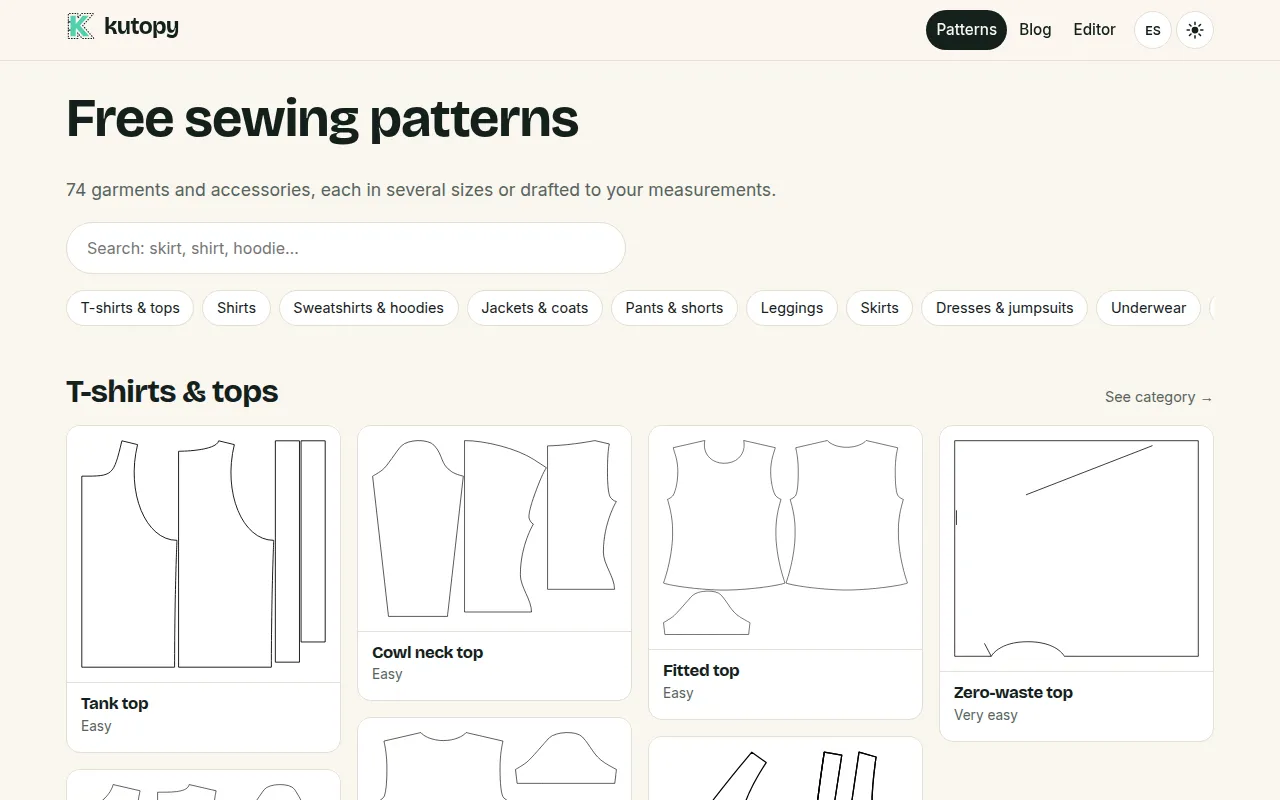
Fabric to start with
Medium-weight cotton: poplin, light canvas or percale. It does not slip, takes chalk well and presses flat, so mistakes unpick without leaving a trace. Leave fine knits, silk, satin and anything that slides through your fingers for later.
The T-shirt and leggings on the path are knits. For those, choose a cotton jersey with some body (not thin T-shirt jersey) and use a narrow zigzag or your machine's stretch stitch.
The bare minimum you need
- A sewing machine with straight and zigzag stitch. No serger needed.
- Fabric scissors you only use on fabric, pins and a tape measure.
- Tailor's chalk or a water-soluble marker.
- An iron. Pressing every seam after sewing it is the difference between home-made and hand-made.
Before you cut your first piece
Read how to read a sewing pattern to understand the lines and notches, and check how much fabric to buy in the fabric chart. If you are between sizes, the editor tutorial explains how to make the pattern to your measurements.
 Try it with your measurementsStart with the apronOpen in the editor
Frequently asked questions
What is the easiest thing to sew for a beginner?
An apron, a zero-waste top or a split-side skirt: few pieces, straight seams and no zips or buttons.
What fabric is best for beginners?
Medium-weight cotton such as poplin or light canvas: it does not slip, presses well and forgives mistakes. Leave knits, silk and satin for later.
Do I need a serger to start?
No. A regular sewing machine with straight and zigzag stitch is enough for every beginner garment.
How do I know if a pattern is easy?
Every Kutopy pattern shows its level: very easy, easy, intermediate, advanced or expert. Also check how many pieces are on the cutting list.
Are beginner sewing patterns free?
Yes. Every Kutopy pattern is free, in standard sizes or to your measurements.


